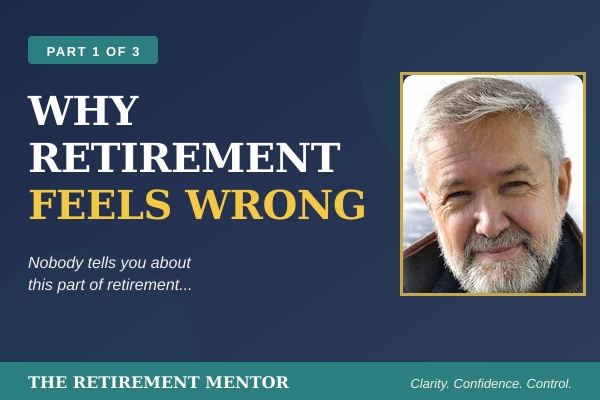
Why Retirement Feels Wrong (and what's really going on)
This is the first part of a 3-part series:
The 3-Part Series
Part 1: Why Retirement Feels Wrong(you are here)
Part 2: Why Your Days Feel Empty
Part 3: Afraid to Spend Your Own Money
They tell you about pensions, they tell you about downsizing, and they tell you about all the things you'll finally have time to do. But nobody, whether it's the financial adviser, your wife, or your mates who retired before you, tells you about the bit that happens about three weeks in. That's when you wake up on a Tuesday morning, realise you've got absolutely nothing you need to do, and find that instead of feeling free, you feel strangely lost.
If you're reading this because something about retirement doesn't feel quite the way you expected, stay with me. I'm going to explain what's really going on, and what you can do about it.
The feeling nobody warns you about
Let me describe something, and you tell me if it sounds familiar. You planned this, you counted down the days, and you might even have had the leaving party where you got the card and the bottle of wine, shook everyone's hand, and drove home thinking," Right. This is it. I'm free." For a week or two, it really was brilliant. You slept in, you went for a walk on a Wednesday morning while everyone else was at work, and you felt like you'd cracked it.
Then somewhere around week three or four, something shifted. You started waking up without any real reason to get up, the days began to blur together so that Monday felt the same as Thursday, which felt the same as Sunday, and you drifted through the afternoon wondering where the morning went before going to bed thinking,"What did I actually do today?"
Here's the part that makes it worse: you felt guilty for feeling this way, because you're supposed to be loving it. You've got your health, you've got your pension, and you've got the one thing everyone always says they wish they had, which is time. So why does it feel so flat?
I know this feeling because I had it myself. I'm a former accountant, and I left work thinking I was ready; I had the spreadsheets done, the pension sorted, and the plan written out. What I didn't have, as it turned out, was any real idea of who I was without the job title.
What you actually lost
Here's what I've come to understand, both from my own experience and from working with other men going through this same transition. When you left work, you didn't just lose a salary; you lost four things that your job had been quietly giving you every single day for decades, and you probably never even noticed them.
1. Your role. For thirty or forty years, when someone asked what you did, you had an answer ready: "I'm an engineer," or "I'm a teacher," or "I'm in finance." That answer wasn't just a job description; it was your identity, and it told you, along with everyone around you, who you were and where you fitted in.
Now someone asks, and you say, "Oh, I'm retired." That word doesn't feel like an identity at all; it feels like the absence of one.
2. Your routine. I don't just mean the alarm clock and the commute, though those mattered more than you'd think. Your job gave you a rhythm to each day and each week, so you knew what Monday morning looked like, you knew when you'd have lunch, and you knew what the afternoon would bring. That structure wasn't really a burden, even though it often felt like one at the time; it was a framework that held your days together. Take it away, and everything feels shapeless, which is why the days start to blur.
3. Your status. I don't mean this in a pompous way; I mean the quiet sense that people needed you, that your opinion mattered, and that you were known for something. In retirement, all of that disappears overnight. Nobody's asking for your input, nobody's cc-ing you on the email, and the phone stops ringing. Even though you might not want to admit it, that stings.
4. Your social circle. Work gave you people: colleagues, faces at the coffee machine, conversation, banter, and a sense of belonging. When you retire, those connections fade surprisingly fast; you said you'd stay in touch with the lads from work, but you haven't. Making new connections in your sixties, without the ready-made social structure of a workplace, turns out to be genuinely hard.
When you add all of that up, whether it's your role, your routine, your status, or your social circle, you start to see that retirement hasn't just changed your schedule. It's changed who you are.
The reframe that changes everything
Here's the thing nobody tells you, and it's the single most important idea in this article.
Retirement is not a financial event. It's an identity shift.
Yes, the money matters, of course it does. But the thing that's making you feel lost right now, that restlessness and sense of drifting, isn't a money problem at all. You've spent your entire adult life building an identity around what you do for a living, and then one day, whether you chose it or whether it chose you, that identity ended, and nothing has replaced it yet.
That's not a failure, a weakness, or a sign of ingratitude; it's the completely normal and completely predictable consequence of one of the biggest transitions a man will ever go through. Once you can see it for what it is, you can start to do something about it.
Your first step
Try this today
Get a piece of paper, or open the notes app on your phone, and write down what you actually miss about work. Not what you're supposed to miss, not what sounds reasonable, but what you genuinely miss when you're honest with yourself.
Maybe it's the structure of knowing what you're doing each morning, or the feeling of being the person people came to with problems. Maybe it's just having someone to have a coffee with at half ten, or the satisfaction of finishing something well and knowing it. Write it all down, and take your time with it.
Then look at your list and notice something important: most of it is not about money. Hardly anything you've written is about your salary, your pension, or your savings; 90% of what you miss is about identity, purpose, connection, or structure. That tells you everything you need to know about what's really going on.
What's next
Once you can see that it's your identity that's shifted, and once you stop blaming yourself for not feeling grateful enough, the next question usually follows on its own: "So what do I actually do with my days now?" That's where most men hit the second wall, because you've got all this time, and somehow none of it feels like yours, so the days feel empty even though they shouldn't. That's exactly what Part 2 of this series is about: how to give your week shape and purpose without recreating the job you just left.
You're not alone
The Retirement Mentor Community is a free space where men work through these same shifts together. Come and join us.

NEWSLETTER and priority blog access
Get monthly insights for free
Do you want early access to the blog and research articles on how to achieve a fulfilling and purposeful retirement? Join my free newsletter.
The Retirement Mentor
© Copyright The Retirement Mentor Ltd • Terms of Service • Privacy Policy
Designed & Developed by Kourse • All Rights Reserved