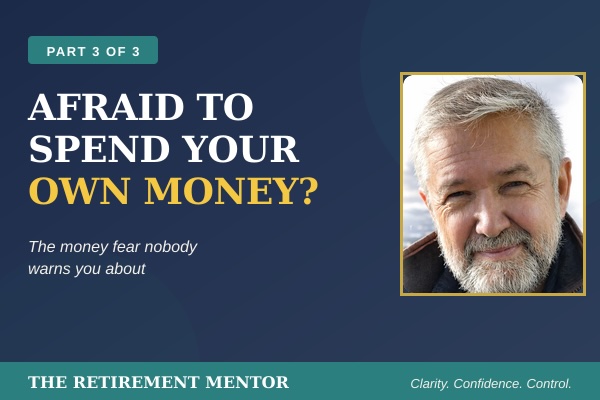
Why You Are Afraid To Spend Your Own Money
PART 3 OF 3
Why You're Afraid to Spend Your Own Money in Retirement
The money fear nobody warns you about.
Prefer to watch?
This article is the written companion to the video. Watch the full 10-minute version on YouTube.
▶ Watch on YouTube
If you have read the first two parts of this series, you are already tackling the two biggest shifts of retirement: the identity side and giving your week some structure. But there's a third problem, and I think it might be the hardest one of all, because it's the one men are most reluctant to talk about.
You have spent forty years saving for this; you have got a pension, savings, maybe an ISA or two. You've done it properly, and you've been careful. Now you're here, you're retired, and the money's sitting there, and you're terrified to touch it. Every time you think about taking something out, your stomach knots up; you check the balance more often than you'd care to admit; and you say no to things you can actually afford, because you don't really know whether you can afford them.
If any of that sounds familiar, stay with me, because in this article, I'm going to show you why this happens, why it's not really a money problem, and the simple shift that takes most of the fear out of it.
What it actually looks like
Let me describe what this looks like in real life, because a lot of men think they're the only ones feeling it. You go out for a meal with your wife, a lovely evening, nothing extravagant: a main course, a glass of wine, pudding if you're in the mood. The bill comes to seventy quid, and you pay it, but on the drive home, you're a bit quiet, because in the back of your mind, you're thinking," Was that alright? Can we really afford to do that?"
Or you're looking at a weekend away, somewhere you'd genuinely enjoy. It's three hundred pounds, and you've got the money sitting there easily, but you find reasons not to book it: the weather might be iffy, you could go later in the year, maybe next month. And perhaps the clearest sign of all is that you check your bank balance, not once a week, not once a day, but sometimes several times a day. Not because anything has changed, but because you need to keep looking at the number to feel alright.
I know this feeling too. For the first couple of years after I retired, every time I used my card for anything more than the weekly shop, there was a little voice asking whether I should have done. And I was an accountant; I knew the numbers, I knew we were fine, and the knot was still there.
Here's what makes it worse: you're supposed to be enjoying retirement, because this is the bit you worked forty years for. Instead, you're watching every pound go out as though you're bleeding slightly. That isn't retirement; it's just worry in a nicer setting.
Why it happens
Why do perfectly sensible men, men who have managed their money well for decades, suddenly find themselves frozen when it comes to spending it? It's not a maths problem; it's a psychological problem, and it's one of the biggest reversals your brain has ever had to deal with.
Think about it. For forty years, money worked one way: it came in every month, you spent some of it, you saved some of it, and the next month it came in again. Even when things were tight, you always knew the next payday was around the corner, and money flowed in. That was the rhythm of your adult life. Then retirement starts, and the rhythm reverses.
Now the money's already there, all of it, sitting in pots and accounts and pensions, and whatever you spend, you're spending from a fixed pile. There's no payday coming to top it back up, and every pound you take out makes the number smaller. That feels completely different to spending when you knew another paycheck was four weeks away.
Your brain has forty years of training that says earning equals safety, and now you're being asked to spend without earning. Your brain doesn't know what to do with that, so it treats every withdrawal like a small threat, as though you're chipping away at the wall that's keeping you safe. That isn't a character flaw; it's a normal and completely predictable response to a psychological shift nobody warned you was coming.
The one-pot trap
Here's what makes this fear so much worse than it needs to be, and it's something I see with almost every man I talk to. You look at your money as one big number. All of it, whether it's the pension, the savings, the ISA, or the bit in the current account, all add up to one total, and that's the number you're watching; the number that goes up or down when you spend.
Here's the problem with that.
When all your money lives in one number, every pound you spend feels identical. You can't tell the difference between paying the gas bill (which you have to do) and spending on a weekend away (which is a choice); they both reduce the same number by the same amount, so your brain treats them the same, and both feel like losses.
Because you can't distinguish between money you have committed to spend, money that's genuinely yours to enjoy, and money you're keeping back for emergencies, you end up paralysed. You don't know what's safe to spend, because it all looks the same. So you spend nothing, or you spend a tiny bit and feel guilty about it, and either way, you're not really living on this money you worked so hard to save. This is what I call the one-pot trap, and almost everybody gets stuck in it when we start.
The shift that changes everything
Here's the shift, and once you see it, you can't unsee it.
Stop looking at your money as one big number. Start separating it by purpose.
Not all your money has the same job. Some of it is already committed, going out on bills whether you like it or not; some of it is genuinely yours to enjoy; and some of it is sitting there as a safety net. Three completely different jobs, and three completely different feelings when you spend from them.
Pot 1: Committed costs
Bills, council tax, food: the non-negotiables. Once this money is in its own pot, the gas bill no longer feels like a loss, because that money was never really yours to enjoy in the first place.
Pot 2: Yours to enjoy
Genuinely yours for meals out, weekends away, hobbies, whatever matters to you. Spending from this pot isn't chipping at your safety; it's doing what the pot was designed for.
Pot 3: Safety net
The reserve for what you can't predict, like a car that breaks down or a roof that leaks. Because you know it's there, you don't have to treat every other pound as though it might be the safety net.
Three pots, three jobs, and once they're separated, something remarkable happens. You stop being afraid of spending, because you finally know what's safe to spend. You can pay the bills without flinching, you can book the weekend away without guilt, and you can sleep at night, because the safety net is a separate thing, not something you're nibbling away at every time you buy a cup of coffee.
Your first step
Don't try to set up all three pots today; that's a bigger job, and we handle it properly within The Retirement Mentor. But you can take the single most useful step today, and it'll give you a clearer picture than you've probably had in years.
Try this today
Grab a piece of paper and divide it into two columns. In the first column, write down your essential monthly costs, the real non-negotiables: mortgage or rent, utilities, council tax, insurance, food, fuel, phone. These are the things that happen whether you want them to or not, so add them all up.
In the second column, write down your guaranteed monthly income: your state pension, any workplace or private pension that's already in payment, and any other income you can absolutely rely on. Add that up too, and then compare the two numbers.
If your guaranteed income covers your essentials, you're in a much stronger position than you probably feel, because your day-to-day life doesn't depend on touching your savings at all. If your guaranteed income doesn't quite cover your essentials, you now know exactly what you're dealing with; it isn't a vague fear anymore, but a specific gap, and once it's a specific gap, you can plan around it.
Either way, you've replaced a vague knot in your stomach with two real numbers, and that's the first step out of the one-pot trap.
Where to go from here
So those are the three shifts: knowing who you are now that the job is gone, giving your week shape without recreating the job you left, and feeling confident with your own money instead of frightened of it. These three things are the foundation of a retirement that actually works, and most men never get past any of them, because nobody told them these were the real challenges, and nobody gave them a way through.
But don't leave these three things sitting, because most men do. Most men drift for years with the identity question, the empty days, and the money fear, never dealing with any of them properly. You don't have to be one of them.
Ready to build the full system?
Inside The Retirement Mentor I've built a complete programme around these three shifts. Deeper identity work, anchor points that actually stick, and the full three-pot system set up properly, with the numbers, reviews and confidence that come with it.
Take the free Financial Health Check https://www.skool.com/the-retirement-mentor/classroom/94519401?md=2c86560ffc754594ba0866bfbeb02d02
The 3-Part Series
Part 1:Why Retirement Feels Wrong
Part 2:Why Your Days Feel Empty
Part 3: Afraid to Spend Your Own Money(you are here)
Clarity · Confidence · Control
theretirementmentor.net

NEWSLETTER and priority blog access
Get monthly insights for free
Do you want early access to the blog and research articles on how to achieve a fulfilling and purposeful retirement? Join my free newsletter.
The Retirement Mentor
© Copyright The Retirement Mentor Ltd • Terms of Service • Privacy Policy
Designed & Developed by Kourse • All Rights Reserved